Issue #25: Looking back

I started writing this newsletter in July this year and the goal was to get consistent with writing. I think I have pretty much achieved my goal. 25 issues later, I felt that it would be a good exercise to re-read all I wrote and compile things I still find relevant in the last newsletter for 2024.
So here are some of the interesting links from July 2024:
[Article: 6 Harsh Truths that will make you a better person]
Usually, articles like these are clickbaity, but this one was a super good read. Contains a lot of profanities. Be warned!) A few points that resonated with me (My notes are written like this):
Does that break your heart? OK, so now what? Are you going to mope about it, or are you going to learn how to do surgery? It's up to you, but don't complain about how girls fall for jerks; they fall for those jerks because those jerks have other things they can offer.
You Hate Yourself Because You Don't Do Anything (Action over everything)
Do the math: How much of your time is spent consuming things other people made (TV, music, video games, websites) versus making your own? Only one of those adds to your value as a human being.
Remember, misery is comfortable. That is why so many people prefer it. Happiness takes effort. Also, courage -- it's incredibly comforting to know that as long as you don't create anything in your life, then nobody can attack the thing you created. It's so much easier to just sit back and criticize other people's creations. (I think this point is the one that hit the most, complaining is easy, but being happy and doing the work to be happy is hard)
[Poem: If by Rudyard Kipling]
Still my favorite poem.
I always thought poems were too abstract. Since the common wisdom says you need to "read between the lines", to truly appreciate a poem, there is always a chance that you over-interpret and find a meaning the author did not even think of! Additionally, there is no way to know if you are right or wrong anyways.
However now, I think this is exactly why you should read a poem. To realize that you can find beauty only if you put in the time, and there are no 0/1 binary interpretations to life. Everyone gets to have their own perspective.
I found this poem on an Instagram reel, and then read the whole thing over and over again.
A few lines that resonated with me: (... is used since these are disconnected lines from the poem)
...If you can wait and not be tired by waiting
...Or being hated, don’t give way to hating, And yet don’t look too good, nor talk too wise:
...If you can force your heart and nerve and sinew
To serve your turn long after they are gone,
And so hold on when there is nothing in you
Except the Will which says to them: ‘Hold on!’
The whole poem is worth reading! And above is a link to Alfred reading it boss style!
[Interesting Article: The Disproportional Power of Anecdotes]
All of us are prone to the tendency of overgeneralizing from small samples, this article tells the importance of knowing what sample size is significant as well as common issues with polling.
A few salient points from the article:
Our propensity to confuse the “now” with “what always is,” as if the immediate world before our eyes consistently represents the entire universe, leads us to bad conclusions and bad decisions. (As mentioned, we over-generalize based on data of irrelevant sample size)
We see a headline screaming out about the state of affairs and we dive right in, instant believers, without pausing to question the validity of the methodology. How many people did they sample? How did they select them? Most polling aims for random sampling, but there is pre-selection at work immediately, depending on the medium the pollsters use to reach people. (Some questions to check if the underlying data made in the claim is statistically relevant)
It matters because generalization is a widespread human bias, which means a lot of our understanding of the world actually is based on extrapolations made from relatively small sample sizes. Consequently, our individual behaviour is shaped by potentially incomplete or inadequate facts that we use to make the decisions that are meant to lead us to success.
So next time you hear the words “the polls say,” “studies show,” or “you should buy this,” ask questions before you take action. (Crux of the article)
[Article: One of my all-time favorite articles on running and mental toughness]
I re-read this article which has a lot of insight on the role of emotional regulation and being a better runner which I think is also transferable to other parts of life. Here are some important points from the article:
- There are two of kinds of self-regulation, and they are often used interchangeably in scientific literature. The first is self-regulated learning, which is important in every kind of sport. It involves taking control of your own development process and using every available opportunity and situation to keep on improving, for example by tackling the steep hill instead of sticking to the flat track or going to training after a hard day’s work or a bad night’s sleep.
- The second kind of self-regulation concerns how to control your emotions, thoughts, and actions and keep them in line with your goals. For example, how do you deal with the inevitable nerves before a race and feelings of boredom and fatigue while you are running?
- “You need to actively seek out situations in which you are forced to confront your own thoughts and emotions. That has the most effect.” -- (If you do not run, let me assure you in every run there comes a point where you know you can go farther but your mind comes up with really creative excuses on why today you shouldn't!)
- “Perception of effort” is a subjective feeling (This is the crux of the article, the whole thing is worth going through but sometimes we stop because we have convinced ourselves that we are out of energy instead of actually being out of energy.)
[Super big article on random advice]
I always like reading such articles, even though you might not relate to all the points, there are always a few you can take with you. The article has 100 points, here’s one that really resonated with me since I am basically being called out in this point :p
“I know the mechanics of an argument, and I’ve learned that everything is about feeling. We have 9x more information going from body to brain, than brain to body. Logic and language were the last frontiers of human evolution, and they will never win over emotion. This is good to keep in mind during an argument when you’re trying to speak logic to feeling; it doesn’t work. Feeling is pre-verbal and needs validation. To resolve an argument, begin by saying “I can see why you…” which is a way to make the conversation about feeling rather than facts.”
[Mini Blog: Red Pill vs Blue Pill]
This concept has become popular recently and was introduced in the movie The Matrix. Essentially accepting the blue pill is staying in the bubble and not accepting reality and accepting the red pill is seeing things for what they are.
In politics, this often means taking a contrarian view on a subject. However, I think there’s one more level of abstraction above it which should be considered as the actual red pill — exiting arguments altogether. I feel that debating about politics is akin to making a to-do list. You feel like you did something productive when in reality all the items on your to-do list are still pending.
After reading some news that made you upset, mad, angry, enraged, or all of these together, ask yourself this — are you going to take any action that will lead to change? Or will you just do “pseudo activism“ like sharing an article or an Instagram post? Will sharing lead to any social change? Then by following the herd and raging on social media, whom did you help? The cause or media channels whose stories you shared?
So, it’s better to just ignore all of it and focus on your goal, hopefully, something that would end up being useful to society at large. I found this article on how obsessively reading news prevents you from doing this.
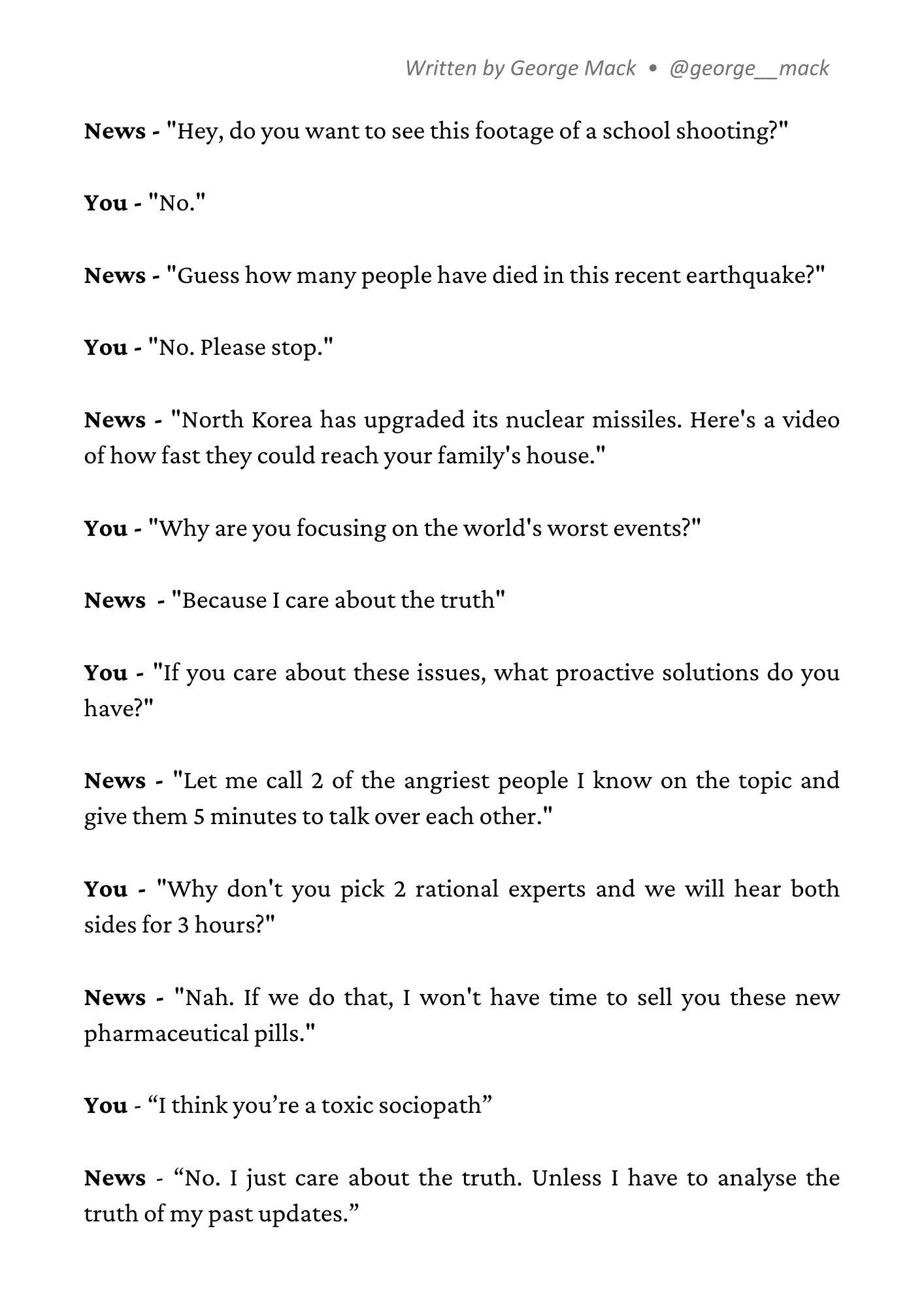
Figure out what the matrix is, and find a way to exit.
[Food for thought: The trap of structuring your life as a cohesive narrative]
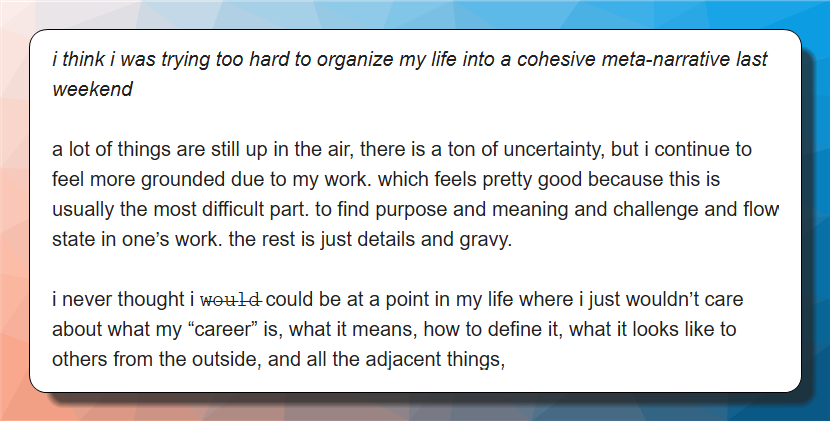
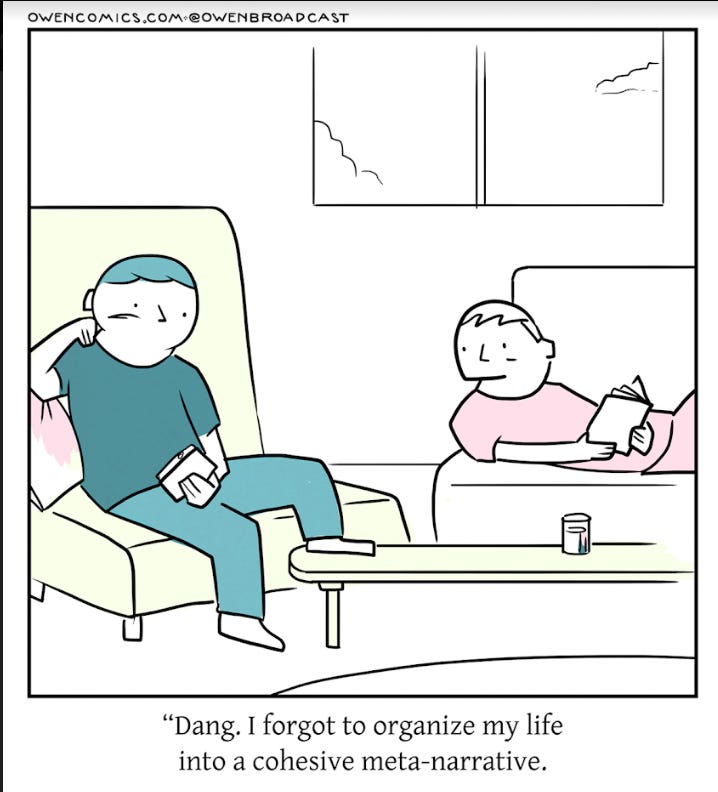
This resonated with me a lot. Many things that happen to us are random, but humans are suckers for narratives and stories, so we try to weave a narrative that makes logical sense. Not just about your career but everything in life. For example, if you do badly on a test and come home to a well-cooked meal, you feel like you don't deserve it.
Even though the two things are completely unrelated, you connect them since they form a narrative.
I think this point was a good reminder that life is mostly random, and always linking events might not be wise!
Here's a meme version if that's your thing.
[Article: On the act of giving without expectations]
(Article is the section titled: V2 | Physics | Reciprocity)
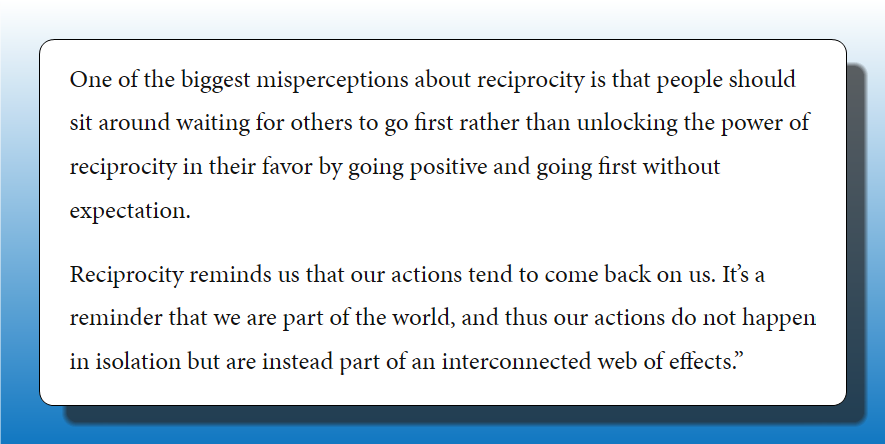
A great read on reciprocity — it talks about why you should just help without any expectations. Here’s a relevant experience I had a few months ago:
On Substack, there used to be office hours where all writers could share their publications and get feedback. I had shared my publication too but did not receive any feedback. But it made sense when I realized I hadn't read anyone else's publication either and hence it was wrong for me to expect any feedback on mine. I think the biggest takeaway from this article is ‘reciprocity should be the default’. Help others without expectation, if you are waiting for others to go first, you are missing the point.
[Article: Why Smart People Believe Stupid Things]
If you read just one article from this week’s newsletter, please, please read this one.
Here are some salient points ([…] is used to indicate partial quotes):
[…] an intelligent agent can’t just be intelligent; it must be intelligent at something,
[…] intelligent people are more easily misled by themselves. They’re better at convincing themselves of things they want to believe rather than things that are actually true.
Motivated reasoning occurs when we place our intelligence and learning into the service of irrational goals. The root of the problem is therefore not our intelligence or learning, but our goals.
Curiosity is essential to directing your intellect toward objective truth, but it’s not all you need. You must also have humility. This is because the source of our strongest biases is our ego; we often base our self-worth on being intelligent and being right, and this makes us not want to admit when we get things wrong, or to change our mind. (One of the ways to avoid being an intelligent idiot)
[…] So instead of defining yourself by your ability to reason, define yourself by your willingness to learn. (Another way)
[…] Without the right personal qualities, more education won’t make you a master of your biases, it’ll only make you a better servant of them. (Why having good ethical and moral values is also important for being a good human)
[…] By being humble and curious you may not win many arguments, but it won’t matter, for even losing arguments will become a victory that moves you toward the far grander prize of truth. (And last but not least, a note to self :P)
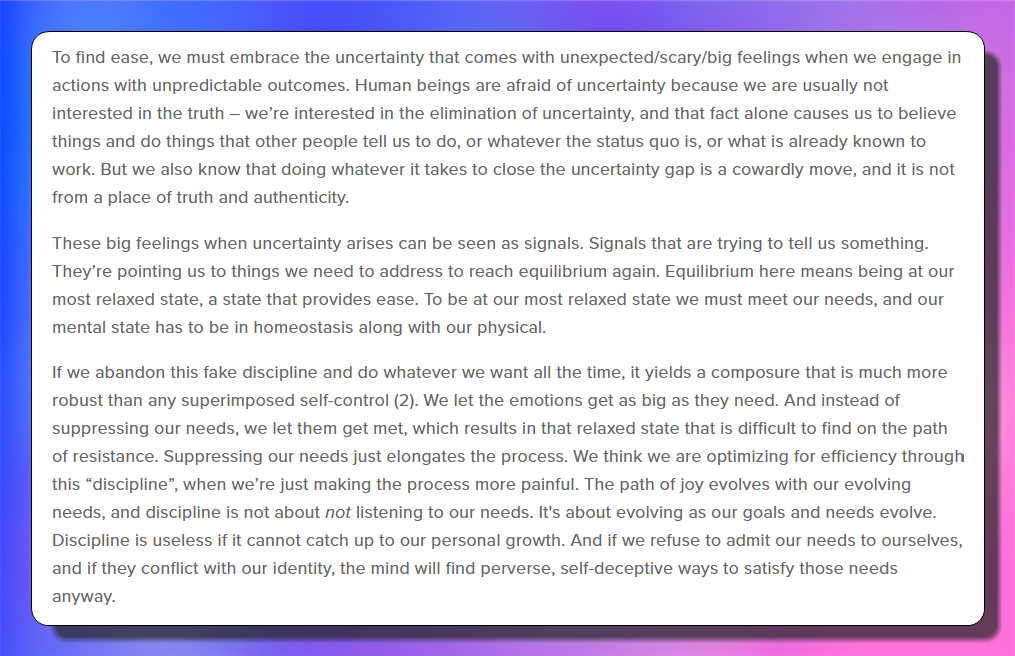
[Article: On evolving forms of discipline]
(Source)
This is another great read about how the definition of discipline should evolve as our goals evolve. Discipline usually starts as a means for self-improvement, so as the definition of self-improvement changes, so should the definition of discipline.
Whenever I see a new concept, I try to see if I can find an extreme example, because in the extremes, the application of such principles is obvious and then you can discern how to apply it in the middle.
So here’s an example I came up with:
When you are young, you need to eat nutrient-rich foods for good growth, so discipline is to eliminate bakery products. However, when you start your Master’s Degree and don’t have time to cook meals all the time, saying yes to bakery foods can mean eliminating foodless nights. (Yes, speaking from personal experience.)
Restriction when the goal is maximizing basic physical growth, and allowance when the goal is to learn a niche subject deeply — both are forms of discipline. Reflect and change the meaning of discipline as your goals evolve.
Here’s my favourite part of the blog:
[Mini Blog: It's hard to follow your own advice]
This week was challenging. I found out about a mistake I made that can be essentially pinned to not being vigilant enough. Since childhood, I was prone to making such mistakes and hence over the years I had made it a point to to make sure I was careful when doing things that cannot be undone. So accepting I made the same mistake was hard to accept.
Especially because in cases like these, you cannot console yourself by saying don't focus on things beyond your control, because this was in my control and I messed up because I was careless.
All in all, I was disappointed in myself and I basically felt like this (maybe not as dramatic, but you get the point)

(Also if you haven't watched Attack on Titan, please do!)
I decided to talk to my friends and all of them basically gave me the advice to keep moving forward since there is no point in stressing over something that cannot be changed. It reminded me of this Charlie Munger quote "Life will have terrible blows in it, horrible blows, unfair blows. It doesn’t matter. And some people recover and others don’t". It basically points out the perils of ruminating over the past. When I read it, I loved the quote and shared it with everyone too!
When it was time for me to follow it, however, I needed to be reminded of it by my friends. It just goes to show it's easy to preach and hard to act.
[Article: A fresh new perspective on inspiration]
After reading millions (obviously an exaggeration) of posts on this topic this was my view on inspiration:
It is scarce, so act upon it immediately.
It follows action and not vice-versa, so start doing stuff anyway.
This article provides a fresh perspective I hadn’t read about before, here’s the gist but the whole article is worth reading:
“You don’t need to live an outwardly exciting life for great inspiration to arise.
Inspiration can also come from within, when you apply grandeur to the ordinary. Through this, you elevate what already exists rather than seeking something which is a spectacle in itself.“
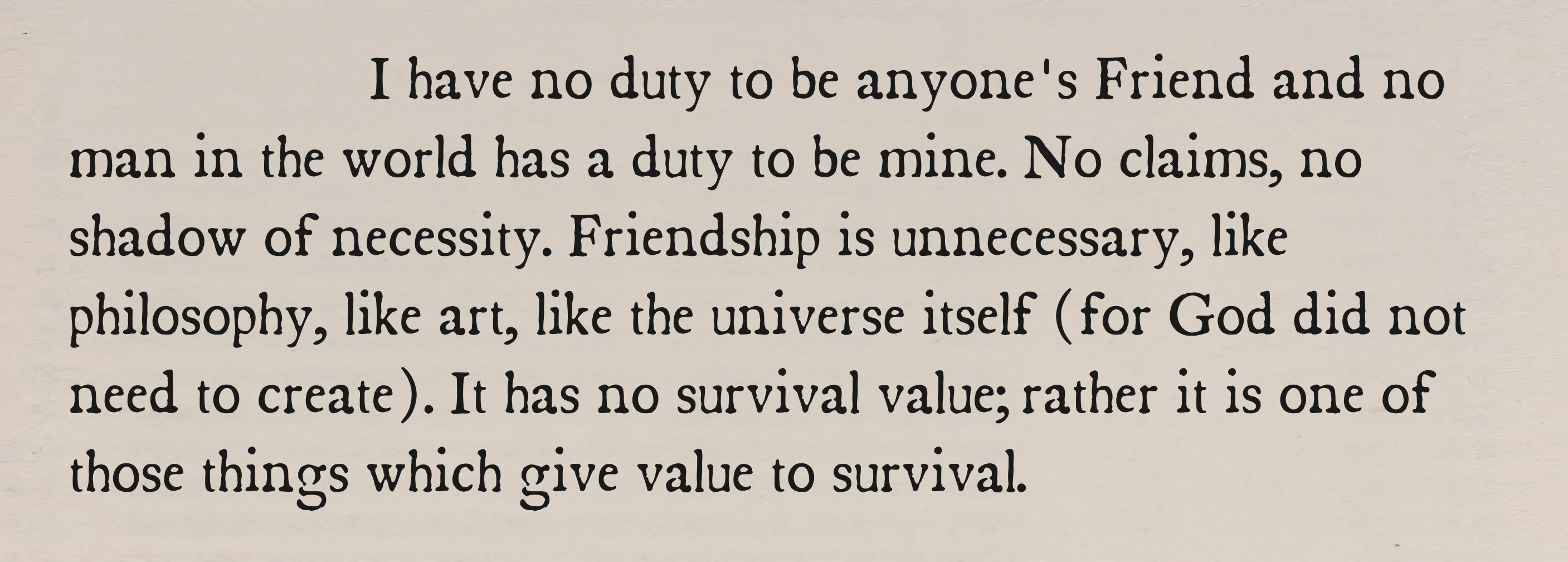
[Food for thought: On the “Unnecessary” Friendship]
I thought about this a lot since reading it. For a person like me, who is always allured by productivity hacks, this doing things with no purpose or utility feels like an antithesis. However, I am fortunate to have truly valuable friendships and hence this idea that something necessary utility-wise can give you so much value was interesting to ponder upon.
[Images]
[Sign Off]
I hope to continue writing this newsletter next year. Let me know if you have any feedback.
Next year पुन्हा भेटू!
I started reading your blogs few months back. You have put in a lot of work at every blog and is a value add. Great job! Looking forward to new series next year:) also , I had a feedback if there's a topic which resonates deeply with you, you could write an entire blog on it( on a specific dimension on music, art etc.)
Feels so proud !